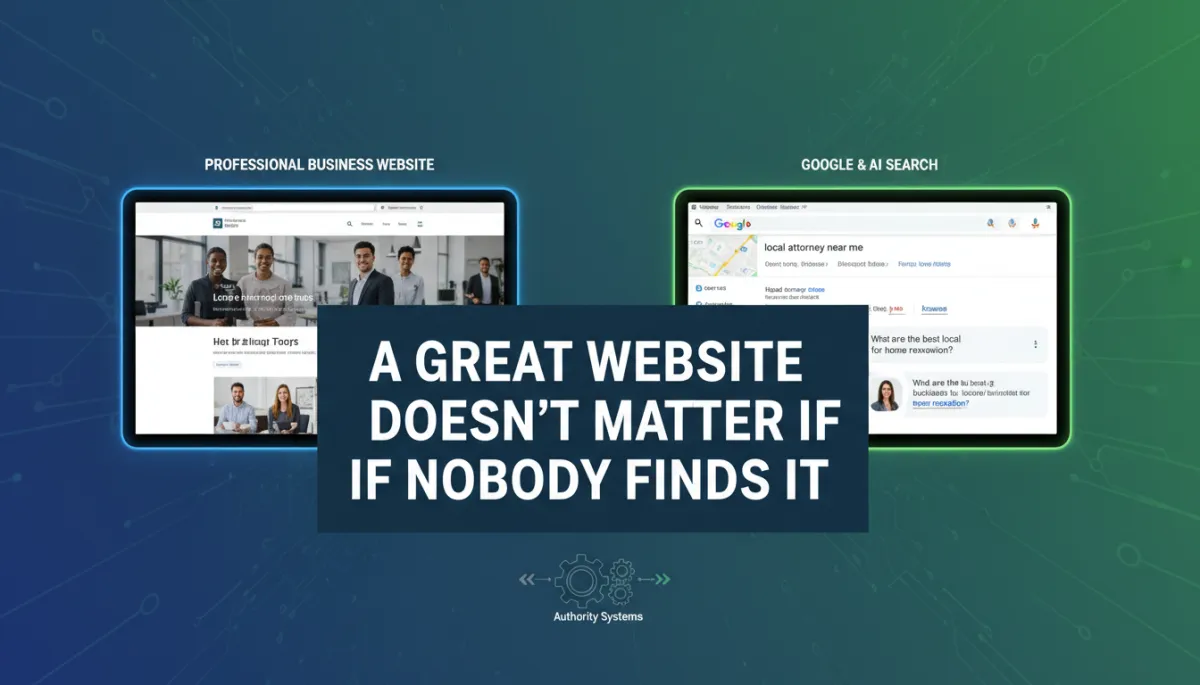
Why Your Stunning Website Isn't Ranking
Local Business Marketing, Digital Authority, Website SEO
Why Your Website Isn't Ranking (Even Though It Looks Great)
If you’re like many attorneys, chiropractors, healthcare providers, contractors, home service businesses, and professional firms, you’ve invested in a modern, great-looking website—yet Google and AI search still aren’t sending you enough leads. This article explains why that happens and what you can do about it by building true Digital Authority across Google, Google Maps, reviews, listings, and today’s AI-powered search platforms.

Why Beautiful Websites Don’t Rank
A modern website is important. It helps you look professional, builds trust with visitors, and supports your brand. But design alone does not answer the question you might be asking right now: “Why my website isn’t ranking?”
Search engines like Google—and now AI tools like ChatGPT, Gemini, Claude, and Perplexity—don’t care how much you paid for your design. They care about how helpful, trustworthy, and authoritative your business appears compared to every other option in your area and industry. In 2026, Google’s guidelines focus heavily on helpful content and trust signals, not on who has the flashiest homepage (developers.google.com).
That means you can have:
A beautiful homepage with strong branding
Professional photos and a clean layout
Mobile-friendly design and a clear menu
…and still be invisible in Google, Google Maps, and AI search results if the deeper signals of authority are missing. Design is the “paint job.” Digital Authority is the engine that actually moves you up in rankings and into AI-generated recommendations.
Google Doesn’t Rank Websites—It Ranks Businesses
One of the biggest mindset shifts for local business owners is this: Google doesn’t rank websites; it ranks businesses. When someone searches “personal injury lawyer near me” or “emergency plumber in [your city],” Google is not only looking at your homepage. It is evaluating your entire online presence as a business entity.
The Signals Google and AI Look At
Website quality: Helpful, original content that answers real questions, clear service pages, strong internal linking, and a structure that makes sense to both humans and search engines. Google now rewards content that shows real-world experience and expertise, not generic text (visiblytics.com).
Google Business Profile: How complete and accurate your profile is, how often you update it, your categories, photos, posts, and Q&A activity—all major local SEO factors (BrightLocal).
Reviews and reputation: Star ratings, review volume, recency, and how you respond. These are powerful trust signals for both Google and AI systems that want to recommend reliable businesses. Trustworthiness is now the most important part of Google’s E‑E‑A‑T framework (craftandcode.agency).
Business listings (citations): Your name, address, and phone number (NAP) across directories like Yelp, Healthgrades, Avvo, HomeAdvisor, and industry-specific sites. Consistency here helps confirm that you are a real, established business in your market.
Local authority: Mentions and links from local chambers, news sites, sponsorships, and community organizations. These tell Google and AI that you matter in your area, not just on your own website.
Helpful content: Articles, FAQs, and resources that answer the exact questions your ideal clients are asking. Content that is thin, copied, or written only for keywords is being filtered out by recent core updates (Google Search Central).
Technical SEO: Site speed, mobile performance, secure HTTPS, crawlability, and Core Web Vitals like loading speed and interaction. These are confirmed ranking factors (seo.com).
Structured data (Schema): Code that helps search engines and AI understand your business type, services, reviews, FAQs, locations, and more. This is essential for Answer Engine Optimization (AEO) and rich results in 2026’s AI-driven search landscape (AI Search Optimization).
Backlinks: Links from other trusted, relevant websites pointing to your site. These act as “votes of confidence” and still matter, especially when they come from respected local or industry sources (reporteroutreach.com).
User experience: How visitors behave on your site—do they stay, read, click, and contact you, or do they bounce back to Google? Poor engagement sends negative signals about relevance and quality.
When you think this way, your question changes from “Why isn’t my website ranking?” to “What does Google and AI actually think about my business?” That’s a much more powerful question—and it leads directly to Digital Authority.
Search Has Changed: It’s Not Just About Google Anymore
For years, “getting found online” mostly meant showing up on the first page of Google. That’s still important, but it’s no longer the full picture. Today, your future customers also ask questions in:
ChatGPT (“Who is the best family lawyer in [city]?”)
Google AI Mode / AI Overviews (“Top-rated chiropractors near me”)
Gemini, Claude, and Perplexity (“Which HVAC company has the best reviews in [area]?”)
These tools don’t just show a list of websites. They generate answers and often highlight only a few businesses as examples. Studies in 2026 show that AI Overviews can reduce clicks to the top organic result by more than half (Ahrefs). At the same time, AI-referred traffic is growing fast and often converts at about twice the rate of traditional organic traffic (Catalyst Q2 2026 Report).
In other words, you are no longer competing just for Google rankings. You are competing to be the business that Google and AI platforms choose to mention by name when someone asks for help. That requires a different, broader approach to visibility: Digital Authority.
Introducing Digital Authority™
Digital Authority™ is the combined strength of every signal that tells Google, Google Maps, and AI search engines, “This is a trusted, established, and helpful business in this market.” It goes far beyond traditional Website SEO and touches every place your brand shows up online.
The Systems That Build Digital Authority
Website Optimization: Turning your site into a fast, clear, and conversion-focused hub with strong on-page SEO, clear calls to action, and content that answers real client questions, not just keyword checklists. This is the foundation of Authority SEO for your brand.
Local SEO: Structuring your site and content to target local search terms, service areas, and city pages so you can show up when people search in your region, not just for generic phrases no one in your town actually uses.
Google Business Profile Optimization: Fully completing and regularly updating your profile with categories, services, photos, posts, and answers to common questions. Businesses with strong profiles earn more views, more calls, and more map impressions (Search Engine Journal).
Directory Listings: Cleaning up and expanding your presence across major directories and niche platforms so your NAP data is consistent and your business is recognized as a real entity across the web. This is critical for local authority and entity-based search in 2026 (Ahrefs).
Reputation Management: Systematically earning, monitoring, and responding to reviews on Google, Facebook, and industry sites. Remember, AI tools want to recommend trusted businesses—your review profile is one of the strongest trust signals you control.
AI Search Optimization & AEO: Structuring your content and data so that AI systems can easily understand what you do, where you operate, and who you serve. This includes Answer Engine Optimization (AEO), semantic SEO, and preparing your site for generative engines that summarize information (Generative Engine Optimization).
Structured Data: Adding Schema markup for local business, services, reviews, FAQs, and more so that both Google and AI platforms can “read” your business details in a structured, machine-friendly way. This is a key part of modern AI Search Optimization and ChatGPT SEO readiness.
Helpful Content: Publishing articles, guides, and FAQs that reflect your real-world experience—not generic AI text. Google’s 2026 updates reward content that shows first-hand expertise and original insight, especially for legal, health, and financial topics (craftandcode.agency).
Technical SEO: Fixing crawl errors, improving Core Web Vitals, ensuring mobile performance, and making it easy for search engines and AI agents to access and understand your content. This is the plumbing behind your Digital Authority that most visitors never see, but Google absolutely does (webtonic.io).
Conversion Optimization: Making sure the traffic you earn actually turns into calls, form fills, bookings, and cases. Search platforms favor businesses that deliver good experiences, and strong conversions are a sign that searchers found what they were looking for.
Digital Authority is what happens when all of these systems work together. It’s not one tactic, one plugin, or one ad campaign. It’s the combined weight of everything that proves your business is the right choice for the people you want to serve.
Why Authority Compounds Over Time
One of the most powerful parts of building Digital Authority is that it compounds. Every improvement you make today makes the next improvement more valuable tomorrow. Over time, it becomes harder and harder for competitors to catch up, even if they suddenly “wake up” and start investing in SEO or ads.
How Compounding Authority Works in Real Life
You publish a new, helpful article answering a common client question. It earns a few backlinks and starts ranking for long-tail phrases. That brings in a handful of new visitors each month—some of whom become clients and leave reviews. Those reviews strengthen your reputation, which helps you rank better for more competitive terms over time. One piece of content triggers a chain reaction of authority signals.
You improve your Google Business Profile and start asking happy clients to leave reviews. Your rating climbs from 4.0 to 4.8. Now, when someone asks an AI assistant for “top-rated [service] in [city],” your business is more likely to appear in that short list of recommended providers. Those extra leads lead to more reviews, which further strengthen your profile. Authority reinforces itself.
You clean up your business listings and add structured data to your site. AI search tools now see consistent information about your address, phone number, practice areas, and service zones. As a result, they are more confident including you in AI Overviews and ChatGPT-style answers. That increased visibility leads to more branded searches, which signals to Google that people are actively seeking you out by name—another mark of authority.
Over months and years, these small wins stack up. Businesses that invest consistently in Authority SEO, Local SEO, AI Search Optimization, and reputation become the “default choice” in their category. Competitors who only focus on a quick website redesign or a short ad campaign struggle to keep up, because they don’t have that deep base of Digital Authority underneath them.
Common Reasons Businesses Don’t Rank (Even with a Great Website)
If your website looks strong but your phone isn’t ringing from Google or AI search, chances are you’re running into one or more of these common problems:
Weak Google Business Profile: Your profile might be incomplete, in the wrong category, missing services, or rarely updated. This makes it hard to rank in Google Maps and the local pack, even if your website is solid.
Few or outdated online reviews: A handful of old reviews, or a rating under 4.2, can hold you back—especially in fields like law, healthcare, and home services where trust is critical. AI systems are unlikely to recommend a business with a weak or unstable reputation profile.
Slow website or poor technical SEO: Pages that load slowly, especially on mobile, create a bad user experience and hurt your Core Web Vitals scores. Google has confirmed these as ranking factors, and AI agents also prefer fast, easy-to-read content structures (webtonic.io).
Missing Schema markup: Without structured data, search engines and AI tools have to guess at key details like your practice areas, service offerings, and locations. That guesswork often means you get skipped in favor of competitors who are easier to understand at a technical level.
Inconsistent business listings: If your business name, address, or phone number are different across directories, algorithms may treat you as multiple businesses or question your legitimacy. This weakens your local authority and can drag down your Google rankings and map visibility.
Thin website content: A few short service pages and a vague “About” page are no longer enough. Google’s 2026 updates penalize shallow, generic content that doesn’t show real expertise or experience (visiblytics.com). If your content could describe any business in your field, it won’t stand out as authoritative or trustworthy.
Weak authority signals: Few quality backlinks, no mentions in local media or industry sites, and little community presence all tell search platforms that you’re not yet a leading voice in your area or niche. Authority SEO is about changing that story over time with real-world proof of leadership and trust.
No AI optimization: If your strategy still treats Google’s blue links as the only goal, you’re missing where search is heading. Without Answer Engine Optimization, structured content, and AI Search Optimization, you’re invisible in the fast-growing world of AI-driven recommendations and ChatGPT SEO opportunities (Ahrefs AI Search Trends).
Poor conversion experience: Even if you do get traffic, confusing navigation, weak calls to action, or hard-to-use forms can cause visitors to leave without contacting you. Search platforms notice when users bounce or don’t engage, and that can hurt your visibility over time.
The good news: every one of these issues can be fixed. But they can’t be fixed by design alone. They require a coordinated Digital Authority strategy.
What Authority Systems™ Does Differently
Many marketing companies sell disconnected services: a website here, some SEO there, maybe a review tool or a few directory listings. The problem is that these pieces rarely work together in a strategic way. You end up with activity, but not Authority.
Authority Systems™ is different. It is not “just an SEO agency.” It is a Digital Authority company built specifically to help local and multi-location businesses become more visible, trusted, and recommended across Google, Google Maps, and today’s leading AI-powered search platforms.
Integrated Growth Systems—Not One-Off Services
Authority SEO™: A holistic approach to Website SEO, Local SEO, Answer Engine Optimization, and AI Search Optimization that focuses on building long-term Digital Authority instead of chasing short-term ranking tricks. It aligns your content, structure, and technical setup with how search and AI actually work in 2026 and beyond.
Authority Reputation™: A system for earning, managing, and showcasing reviews across Google, industry platforms, and key directories. This turns your happy clients into one of your strongest ranking and conversion assets, reinforcing trust signals that both Google and AI platforms value highly.
Authority Listings™: Centralized management of your business listings and citations to ensure your NAP data is accurate, consistent, and visible across the web. This strengthens your local authority and helps AI systems recognize your business as a single, clear entity across multiple sources.
Authority AI Optimization™: Strategies and structures designed specifically for AI-powered search, including AEO, semantic markup, and content formats that AI answer engines prefer. The goal is to help your business show up when people ask tools like ChatGPT, Gemini, or Claude for recommendations in your category and city—increasing your AI visibility and capturing high-intent leads.
Authority Website Optimization™: Ongoing improvements to your site’s speed, structure, content depth, and conversion paths. This ensures your website is not only attractive, but also technically sound, easy for AI agents to read, and effective at turning visitors into clients or patients.
AuthorityIQ™ Executive Preview: A high-level diagnostic that shows you where your Digital Authority stands today across website performance, Google visibility, AI visibility, reputation, listings, and competitive positioning—and where the biggest opportunities lie.
Each of these systems is designed to support the others. Reviews strengthen your Google Business Profile. Listings reinforce your local authority. Website improvements help AI understand your expertise. AI visibility drives more branded searches, which further boost your reputation and rankings. This is how Digital Authority is built—not in silos, but as a connected, compounding strategy.
Practical Takeaways You Can Use Today
Even before you hire a partner, there are practical steps you can take right now to start improving your online visibility and building Digital Authority.
1. Strengthen Your Google Business Profile
Log in and make sure your name, address, phone, website, and hours are accurate and consistent with your website and other listings.
Choose the most accurate primary category (e.g., “Personal Injury Attorney” instead of just “Lawyer”) and add relevant secondary categories.
Upload recent, high-quality photos of your office, team, and work. Profiles with photos get more clicks and direction requests (WordStream).
Add a short, keyword-aware description that clearly explains who you help and what you do in plain language.
2. Start a Simple Review Routine
After a successful case, visit, or project, personally ask your client to leave a Google review. Make it easy by sending them a direct link via text or email.
Respond to every review—good or bad—with a brief, professional message. This shows both people and algorithms that you care about customer experience and are actively engaged with your community.
3. Fix “Why My Website Isn’t Ranking” Basics on Your Site
Make sure each core service has its own dedicated page with at least 600–800 words of clear, helpful content that answers common questions, explains your process, and includes your city or service area naturally in the text and headings. This is simple, effective Website SEO that many competitors still skip.
Add obvious calls to action on every page: phone number, contact button, “Request an appointment,” or “Schedule a consultation.” Don’t make visitors hunt for how to reach you.
4. Claim and Clean Up Your Listings
Search your business name and city. Make a list of all the directories where you appear (Yelp, Avvo, Healthgrades, HomeAdvisor, etc.).
Claim any unclaimed listings and correct your name, address, and phone number so they match exactly across all platforms. This strengthens your local SEO and reduces confusion for both people and algorithms.
5. Publish One Helpful Resource This Month
Think about the last five questions a new client asked you during a consultation or first visit. Pick one and write a clear, non-technical answer on your blog or resources page. Include your city and service area where it makes sense, but focus on being genuinely helpful. This is the kind of expert, experience-based content Google and AI are now rewarding.
None of these steps require advanced technical skills. But each one moves you closer to being the kind of business that Google, Google Maps, and AI assistants feel confident recommending.
Conclusion: You’re Competing to Be the Trusted Recommendation
The rules of online visibility have changed. You’re no longer competing just for a blue link on page one of Google. You’re competing to become the trusted business that Google, Google Maps, and AI platforms recommend when someone in your city asks for help with the exact problems you solve.
A beautiful website is still valuable, but it’s only one piece of the puzzle. Real growth now comes from building Digital Authority—across your website, your Google Business Profile, your reviews, your listings, your content, your technical foundation, and your presence in AI-driven search experiences. When those pieces work together, you become the obvious choice in your market, online and offline.
Next Step: Request Your AuthorityIQ™ Executive Preview
If you’re serious about turning your website and online presence into a steady source of qualified leads, the best next step is to see where you stand today. That’s exactly what the AuthorityIQ™ Executive Preview is designed to do.
This complimentary report gives you a clear, non-technical overview of your current Digital Authority across:
Website performance: How fast, clear, and search-ready your site is today, including key Website SEO and technical SEO indicators that affect both rankings and AI visibility.
Google visibility: Where you’re showing up (and where you’re not) in organic search and Google Maps for the searches that matter most to your business.
AI visibility: How well-positioned your business is to be cited and recommended by AI-powered platforms, including opportunities for AI Search Optimization, AEO, and ChatGPT SEO improvements based on current best practices (Ahrefs AI Search Trends).
Google Business Profile: The strength of your profile, categories, photos, posts, and engagement compared to top competitors in your area and vertical.
Online reputation: Your review volume, ratings, recency, and response patterns—and how they impact both human trust and algorithmic trustworthiness signals under Google’s E‑E‑A‑T guidelines (craftandcode.agency).
Business listings: The accuracy and consistency of your NAP data across key directories and how that supports or weakens your Local SEO and entity-based visibility in AI search environments.
Competitive positioning: How your Digital Authority compares to other leading businesses in your category and market, including where they’re outpacing you and where you have clear opportunities to lead.
Overall Digital Authority: A concise summary of your strengths, gaps, and the specific Authority Systems™ growth levers—Authority SEO™, Authority Reputation™, Authority Listings™, Authority AI Optimization™, and Authority Website Optimization™—that can move the needle fastest for your business.
From there, you receive a customized roadmap that outlines practical next steps—what to fix first, what to improve next, and how to build a compounding base of Digital Authority over the next 6–12 months. No hype, no jargon, just a clear strategy you can understand and act on.
If you’re ready to move beyond a great-looking website and become the business that Google, Google Maps, and AI platforms actually recommend, request your AuthorityIQ™ Executive Preview and see exactly what’s possible for your firm, practice, or local service company.