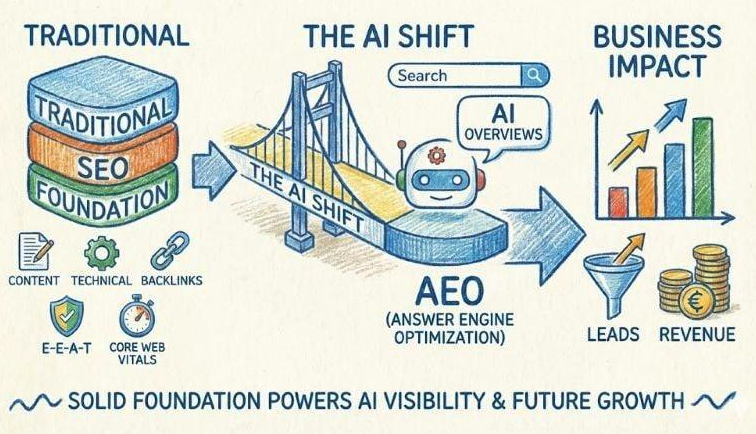
Why Building Your Online Infrastructure Must Come Before Marketing in 2026
“This is not rocket science. Stop spending money on marketing until this is fixed. Then, focus on new clients.”
— Christopher Heeb, Co-Founder, Authority Systems
Why Building Your Online Infrastructure Must Come Before Marketing in 2026
One of the biggest mistakes businesses make is investing in advertising before building the digital foundation needed to convert visitors into customers.
In 2026, marketing is no longer just about getting found on Google. Businesses must now be visible across Google Search, Google Maps, ChatGPT, Gemini, Perplexity, Bing, Apple Maps, Yelp, Facebook, and dozens of other online data sources that influence purchasing decisions.
Before spending money on SEO, social media, pay-per-click advertising, or AI-powered marketing campaigns, businesses should focus on strengthening their online infrastructure.
Think of it this way:
If marketing is the fuel, your online infrastructure is the engine.
No amount of fuel will help if the engine isn't running properly.

What Is Online Infrastructure?
Your online infrastructure is the collection of digital assets that support your online visibility and credibility.
This includes:
Your website
Google Business Profile
Online directory listings
Reviews and reputation
Social media profiles
Business information consistency
Local citations
AI search visibility
Conversion tools and lead capture systems
These assets work together to tell search engines and AI systems that your business is legitimate, trustworthy, and relevant.
Why Google and AI Search Care About Infrastructure
Search engines and AI platforms are becoming increasingly sophisticated.
Instead of simply ranking websites based on keywords, they now evaluate:
Business authority
Trustworthiness
Consistency of information
Review signals
Website quality
User engagement
Local relevance
Third-party validation
When ChatGPT, Gemini, Perplexity, and Google's AI Overviews recommend businesses, they often pull information from multiple sources across the web.
If your business information is inconsistent or incomplete, these systems may overlook your company entirely.
Signs Your Infrastructure Needs Improvement
Many business owners believe they have a marketing problem when they actually have an infrastructure problem.
Common warning signs include:
Low Google Map Visibility
Your business rarely appears in local searches.
Inconsistent Business Information
Different websites show different phone numbers, addresses, or hours.
Few Online Reviews
Customers cannot easily find proof of your reputation.
Outdated Website
Your website looks old, loads slowly, or lacks clear calls to action.
Missing Business Listings
Your company is absent from important directories and citation sources.
Limited AI Search Presence
Your business rarely appears in AI-generated recommendations or answers.
The Five Pillars of Digital Infrastructure
1. Website Authority
Your website serves as your digital headquarters.
It should:
Load quickly
Be mobile friendly
Include service-specific pages
Answer customer questions
Demonstrate expertise
Include clear contact information
2. Google Business Profile Optimization
Google Business Profile remains one of the most important local ranking factors.
Businesses should regularly:
Update photos
Publish posts
Respond to reviews
Verify business information
Add services and products
3. Review Generation
Reviews are no longer optional.
Consumers trust online reviews almost as much as personal recommendations.
Businesses should implement systems that consistently generate new reviews from satisfied customers.
4. Citation Consistency
Your Name, Address, and Phone Number (NAP) should be identical everywhere online.
Inconsistent information creates confusion for both search engines and AI systems.
5. AI Search Readiness
AI search is rapidly changing how customers discover businesses.
Companies should focus on:
Structured website content
FAQ pages
Authority-building content
Consistent online information
Strong review profiles
Build First, Then Market
The most successful businesses in 2026 follow a simple strategy:
Step 1:
Build and strengthen online infrastructure.
Step 2:
Establish authority and trust signals.
Step 3:
Optimize for search engines and AI platforms.
Step 4:
Launch marketing campaigns.
When infrastructure is built first, every marketing dollar works harder.
Traffic converts better.
Lead quality improves.
Customer trust increases.
And long-term growth becomes much easier to achieve.
Final Thoughts
Marketing should amplify a strong foundation—not compensate for a weak one.
Before investing heavily in advertising, businesses should evaluate the health of their online infrastructure.
A properly built digital foundation improves visibility across Google, Maps, AI search engines, review platforms, and social media while creating a better experience for potential customers.
In today's digital landscape, businesses that invest in infrastructure first will outperform competitors who focus only on marketing.
The companies winning in 2026 are not necessarily spending more on marketing.
They're building stronger online authority.
Ready To Learn How To Use AI In Your Business?
Authority Systems helps businesses implement AI-driven systems that improve communication, automation, SEO, reputation management, customer engagement, and online visibility.
If you want to learn how AI can help your business grow smarter and more efficiently, now is the time to start building your systems for the future.
Get ahold of Authority Systems today and make sure your business is built on a foundation Google can trust.